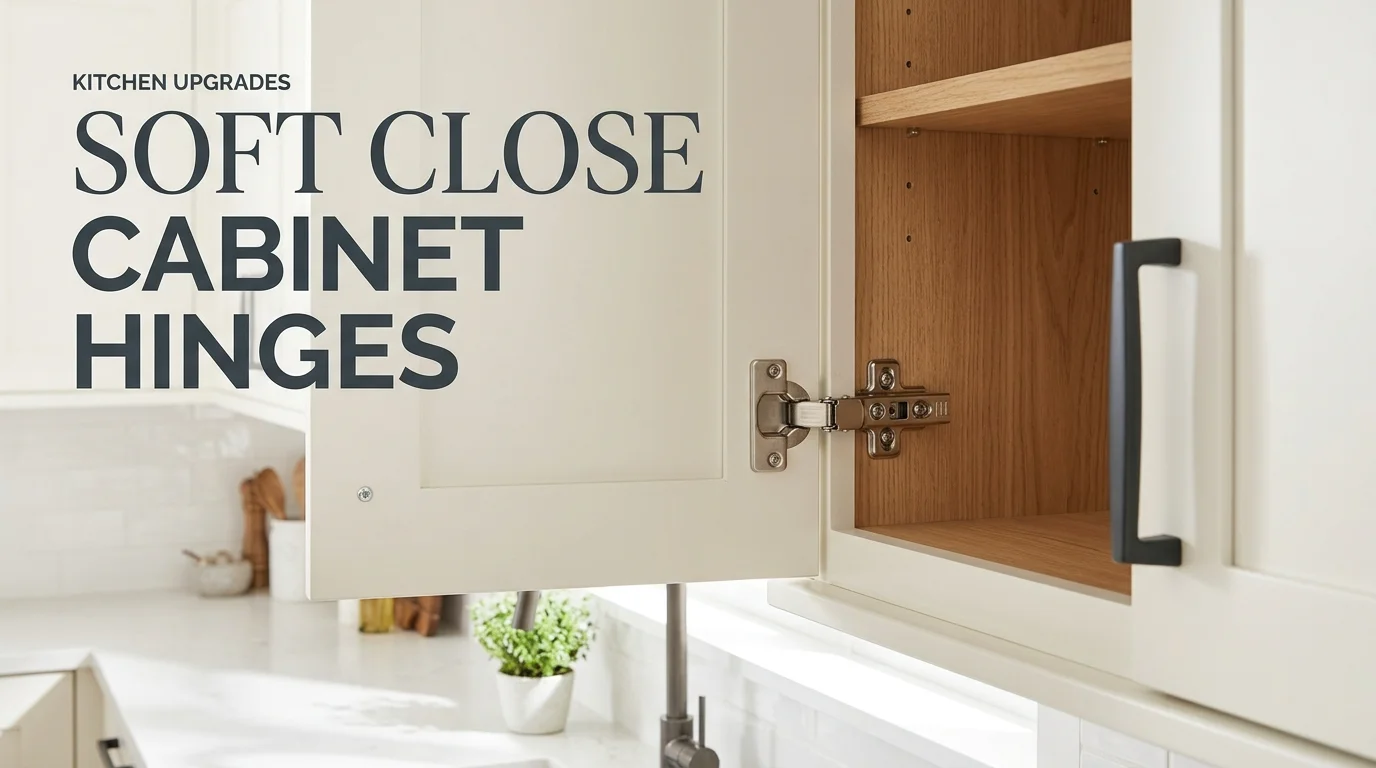
Soft close cabinet hinges can make a kitchen quieter while reducing repeated impact on doors and cabinet frames. However, the correct hinge depends on your cabinet construction, door overlay, existing drilling, and desired opening angle. Measuring these details before buying helps prevent poor alignment, binding doors, and unnecessary redrilling.
Quick answer: Choose a soft-close hinge that matches your cabinet type, door overlay, existing cup holes, and mounting plate. Many concealed hinges use a 35 mm cup, but compatibility still varies. Existing cabinets may accept replacement hinges or separate dampers, depending on their current hardware.
Soft-Close Hinge Quick Reference
| Factor | What to Check | Why It Matters |
|---|---|---|
| Cabinet construction | Face-frame or frameless | Determines mounting style |
| Door position | Full overlay, partial overlay, or inset | Determines hinge geometry |
| Cup diameter | Measure existing bore | Helps match concealed hardware |
| Mounting plate | Position and screw spacing | Affects replacement compatibility |
| Opening angle | Manufacturer specification | Controls door clearance |
| Adjustment | Side, height, and depth controls | Helps align doors |
| Retrofit condition | Existing hinge type and holes | Determines installation difficulty |
| Door size | Height, width, thickness, and weight | Helps determine hinge quantity |
Key Takeaways
- Identify whether your cabinets are face-frame or frameless before shopping.
- Measure the actual door overlay rather than judging it by appearance.
- A 35 mm cup is common, but it should never be assumed without measuring.
- Integrated dampers usually provide a cleaner retrofit when compatible hinges already exist.
- Separate soft-close dampers may be easier when the existing hardware remains serviceable.
- Inset doors need hinges designed specifically for inset applications.
- Always check the hinge manufacturer’s measurements before drilling new holes.
How Do Soft Close Cabinet Hinges Work?
Soft close cabinet hinges use a damping mechanism to control the final part of the door’s movement. The mechanism slows the door before it reaches the cabinet box or face frame. This creates a controlled closing action instead of a sudden impact.
Soft-close action should not be confused with ordinary self-closing action. A self-closing spring pulls a door toward the closed position but may still hit the cabinet with force. A soft-close mechanism adds resistance that slows the movement near the end.
Most concealed designs place the mechanism within the hinge arm or an attached component. Some systems let you adjust or disable the damping feature for lighter doors. Controls vary by manufacturer, so product instructions remain important.
Choosing Soft Close Cabinet Hinges for Your Cabinet Type
Your first buying decision isn’t brand, finish, or price. First, determine how your cabinet box and door are constructed. A compatible hinge must connect the door to the cabinet while maintaining the intended reveal.
Face-Frame Cabinets
Face-frame cabinets have a structural frame attached across the cabinet box front. The door hinge usually connects to that frame or uses hardware designed around it. This construction remains common in many traditional American kitchens.
Do not assume any concealed hinge will fit a framed cabinet. Mounting plates, hinge arms, and overlay ratings vary by product. Measure your existing installation before selecting replacement hardware.
If your boxes remain structurally sound, hinge upgrades can pair naturally with kitchen cabinet refacing. Refacing keeps the cabinet boxes while updating doors, finishes, and hardware. That makes hinge replacement easier to plan as part of one project.
Frameless Cabinets
Frameless cabinets lack the separate wood frame found across a face-frame box. Concealed hinges usually mount directly to the cabinet’s inside wall. This construction often makes hinge adjustments straightforward.
A frameless cabinet still requires the correct overlay and mounting plate. Similar-looking hinges can position the door differently after installation. Compare every critical measurement against the manufacturer’s specifications.
Cabinet door clearance also matters in narrow kitchens. Renovixa’s galley kitchen layout guide covers planning for tighter spaces and storage areas. Proper hinge selection can help doors operate without interfering with nearby walls or appliances.
Inset Cabinet Doors
Inset cabinet doors sit within the cabinet opening rather than covering the front edge. Their visible gaps make alignment errors easier to notice. They therefore require hardware designed for the specific inset configuration.
Don’t substitute an overlay hinge because its dimensions look similar. The hinge geometry determines where the door sits after closing. An incorrect model can leave the panel proud, recessed, or uneven.
Measure the Overlay Before Buying
Overlay describes how far a closed cabinet door covers the opening or adjacent frame. It is one of the most important measurements when replacing concealed hardware. Two doors that look similar may still require different hinge specifications.
A simple tape method can help measure an existing overlay. Close the door and mark its edge on the cabinet with removable painter’s tape. Open the door, then measure from that mark to the edge of the cabinet opening.
Record the measurement rather than relying on labels such as full or partial overlay. Manufacturers may describe their hinge applications differently. The published dimensional drawing provides a safer basis for comparison.
Common door arrangements include:
- Full overlay: The door covers most of the cabinet edge or frame area.
- Partial overlay: Part of the cabinet frame remains visible around the closed door.
- Half overlay: Two nearby doors may share the same cabinet partition.
- Inset: The door rests inside the opening instead of covering it.
Check the Cup Hole and Mounting Pattern
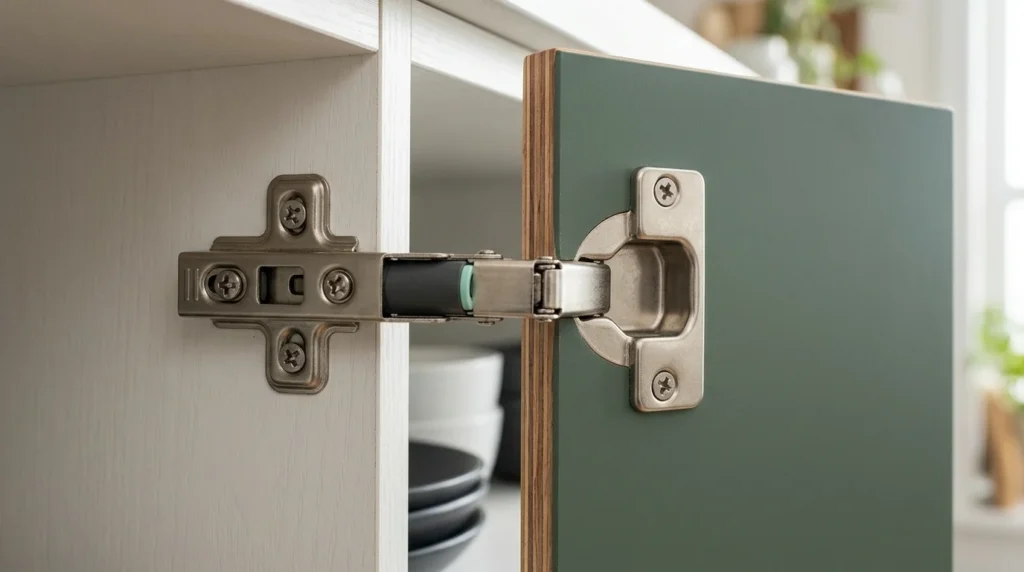
Many modern concealed hinges use a circular cup bored into the back of the cabinet door. A 35 mm diameter is common across European-style hinge systems. However, cup depth, edge distance, and screw locations can still vary.
Remove one existing hinge before ordering replacement hardware. Measure the cup diameter, cup depth, screw spacing, and distance from the door edge. Photograph the hinge markings to help when comparing specifications.
Replacing compatible hardware may let you reuse existing holes. Changing hinge styles can require new boring, filled holes, or mounting changes. Careful measurements can therefore save substantial rework during a multi-door project.
Integrated Hinges vs. Add-On Soft-Close Dampers
Homeowners do not always need to replace every existing hinge. The better approach depends on whether the current hardware is compatible, aligned, and still mechanically sound. Add-on damping may solve the closing problem without changing door positioning.
| Option | Main Advantage | Main Limitation | Good Fit For |
|---|---|---|---|
| Integrated soft-close hinge | Damping built into hardware | Requires correct replacement fit | Planned hinge replacement |
| Clip-on compatible damper | Uses existing hinge system | Compatibility can be limited | Compatible concealed hinges |
| Cabinet-mounted damper | May avoid hinge replacement | Adds another visible interior part | Older working hardware |
| Full hardware conversion | Updates function and adjustment | More drilling may be required | Larger cabinet renovation |
Integrated soft-close hardware is usually cleaner when you already plan to replace worn hinges. An add-on damper makes more sense if the current hinges work properly. Test one door first before purchasing hardware for an entire kitchen.
Can Existing Cabinets Be Converted to Soft Close?
Many existing cabinets can gain soft-close action without replacing the cabinet boxes. Concealed hardware often provides the simplest path because matching replacement systems are widely available. Older exposed hinges may require a different approach.
Start by removing one door or one hinge for inspection. Identify the hinge style, mounting position, door overlay, and existing holes. Then compare those details with the replacement manufacturer’s technical drawing.
Cabinets with unusual exposed hinges may require new drilling or separate damping hardware. In that situation, avoid forcing an incompatible concealed hinge into the existing layout. A small test installation can reveal problems before every door is modified.
Soft Close vs. Self-Closing Hinges
Soft close and self-closing describe different functions. A self-closing hinge uses spring tension to pull the door toward the cabinet. A soft-close system controls its speed near the closed position.
Some products combine both actions within the same hinge. Others provide only one function, despite similar appearances in online listings. Read the specifications carefully instead of relying on product photographs.
In kitchens, homeowners most often notice controlled closing. It reduces sudden door movement and makes everyday operation quieter. Proper alignment still matters because damping cannot correct incorrect hinge geometry.
How Much Adjustment Do You Need?
Adjustment features help correct small differences between cabinet doors after installation. Many concealed systems provide controls for side-to-side, depth, and vertical positioning. The exact adjustment range depends on the hinge and mounting plate.
These controls help create even reveals across several doors. They are especially useful after refacing, replacing doors, or changing mounting hardware. Adjustment cannot compensate for a hinge designed for the wrong overlay.
Make small changes and check the closed door after each adjustment. Large screw movements can make alignment harder to diagnose. When multiple doors need correction, first establish one properly aligned reference door.
Common Soft-Close Hinge Buying Mistakes
The most expensive mistakes usually happen before installation begins. Buyers often focus on appearance while ignoring dimensions and cabinet construction. Taking five measurements first can prevent most compatibility problems.
Avoid these common errors:
- Ordering before identifying face-frame or frameless construction.
- Assuming every concealed hinge uses identical mounting dimensions.
- Guessing the overlay instead of measuring it.
- Installing overlay hardware on an inset door.
- Reusing mounting plates without confirming compatibility.
- Ignoring door thickness and weight recommendations.
- Buying a full kitchen quantity before testing one door.
- Drilling new holes before checking the manufacturer’s boring diagram.
Planning the hardware alongside other improvements can make a kitchen project easier. Renovixa’s Kitchen section covers cabinet, appliance, layout, and remodeling topics. These resources can help connect a small hardware upgrade with broader renovation decisions.
When Should You Replace the Hinge Instead of Adjusting It?
Adjustment makes sense when the door remains securely mounted and the hinge moves normally. Loose screws or small alignment differences may be corrected without replacing the hardware. A failed damper or damaged hinge often requires replacement instead.
Inspect the mounting points before blaming the closing mechanism. Repair stripped screw holes, damaged doors, or deteriorated cabinet material first. Installing a new hinge in weak material won’t fix the underlying problem.
Replacement also makes sense when existing hardware lacks useful adjustment. A compatible adjustable system can make future alignment easier. Confirm the new hardware fits before changing every door.
Frequently Asked Questions About Soft Close Cabinet Hinges
Are Soft Close Cabinet Hinges Worth Installing?
They can be a worthwhile upgrade if you want quieter operation and controlled door movement. They also reduce the repeated impact created by doors closing abruptly. The value depends on buying hardware that correctly fits your cabinets.
Can I Put Soft-Close Hinges on Old Cabinets?
Often, yes, but compatibility depends on the original construction and hardware. Existing concealed hinges may accept matching replacements or compatible damping accessories. Older exposed hardware can require more drilling or a separate damper.
Are All Concealed Cabinet Hinges Soft Close?
No, concealed describes how the hinge is positioned when the cabinet door closes. A concealed hinge may operate standard, self-closing, or soft-closing. Check the product description for an integrated damper or compatible damping accessory.
What Size Cabinet Hinge Do I Need?
No single hinge size fits every cabinet. Measure the door overlay, cup bore, mounting pattern, door thickness, and cabinet construction. Match those measurements to the manufacturer’s specifications before ordering.
Do All Soft-Close Hinges Use a 35 mm Cup?
No, although 35 mm cups are common among concealed European-style systems. Other designs and dimensions exist, especially on older cabinets and specialized hardware. Measure the existing cup instead of assuming its diameter.
Can You Add Soft Close Without Replacing the Hinges?
Sometimes, compatible clip-on or cabinet-mounted dampers can add controlled closing to existing hardware. The current hinge must still operate correctly and support the chosen accessory. Test compatibility on one cabinet door before purchasing multiple dampers.
A Better Way to Plan Your Hinge Upgrade
Start with one representative cabinet door rather than ordering hardware for the entire room. Measure it, identify the construction, and compare those measurements with a manufacturer’s technical drawing. Install one test hinge or damper and confirm the door closes correctly.
Once the test door works, repeat the same process across cabinets with matching construction. Check corner cabinets, tall pantry doors, inset panels, and unusual door sizes separately. Those locations may require different hardware from standard upper cabinets.
For more remodeling ideas, browse Renovixa’s kitchen improvement resources before planning the rest of your project. A measured, compatibility-first approach reduces wasted hardware and avoidable drilling. It also gives you the quiet closing action you wanted without creating a new alignment problem.