A furnace replacement is worth considering when an older heating system becomes unreliable, expensive to repair, or unable to keep the house comfortable. U.S. homeowners commonly face installed costs in the mid-four figures, though efficiency, fuel type, home size, venting, and duct changes can push the price higher. The best decision starts with confirming whether the existing equipment truly needs replacement and then comparing itemized quotes based on the same scope. More from us: AC Compressor Replacement Cost.
| Key question | Practical answer |
| Typical U.S. cost | Many common projects fall around $2,800–$7,500, while complex or high-efficiency installations can cost more. |
| Common replacement age | Around 15 years is a useful point to begin evaluating condition, repairs, and efficiency. |
| Biggest price factors | Fuel type, heating capacity, efficiency, venting, duct changes, permits, and local labor |
| Typical project time | A straightforward swap may fit within one workday, while added duct, vent, or utility work can extend the schedule. |
| Efficiency measure | AFUE shows the percentage of fuel energy converted into useful space heat. |
| Federal tax credit in 2026 | The federal Energy Efficient Home Improvement Credit no longer applies to property placed in service after December 31, 2025. |
| Best first step | Get an accurate load assessment and compare two or three itemized contractor proposals. |
Replacing an aging heating system usually makes sense when it is around 15 years old, needs frequent or costly repairs, or can no longer heat the home evenly. In 2026, common U.S. installed prices often land in the mid-four figures, while high-efficiency or complex jobs can reach $10,000 or more.
Key Takeaways
- Start evaluating replacement once heating equipment approaches 15 years old or repair frequency rises.
- Compare total installed prices rather than equipment-only prices.
- Ask how the contractor determined the correct heating capacity for your home.
- Higher AFUE can reduce fuel waste, but installation changes may increase upfront cost.
- Check local utility and state incentives instead of assuming a federal 2026 tax credit is available.
- Compare itemized quotes that cover removal, permits, venting, controls, startup, and warranty terms.
Furnace Replacement Cost in 2026: What U.S. Homeowners Can Expect
National cost guides do not give one universal price because every home and installation is different. HomeAdvisor reports a common range of about $2,823 to $6,897, while Fixr places furnace replacement many projects between $2,800 and $7,500. Other current estimates show higher totals for premium gas equipment, new venting, or more complicated installations, which is why a local load assessment and written proposal matter more than a single national average.
| Project type | 2026 national planning range | What can move the price? |
| Electric heating unit | About $2,500–$6,000 | Electrical capacity, controls, home size |
| Standard gas system | About $3,500–$8,500 | Capacity, labor, venting, permits |
| High-efficiency gas system | About $6,000–$12,000 | Condensing venting, drains, controls, installation complexity |
| Complex replacement | May exceed typical ranges | Duct repairs, utility changes, hazardous-material work, difficult access |
The quote should also state what is excluded. Old-equipment removal, thermostat changes, permits, sheet-metal transitions, vent modifications, condensate drains, and duct repairs can change the final bill when they are not part of a basic swap. A low starting price is less useful than a complete scope that lets you compare contractors on equal terms.
7 Signs It May Be Time to Replace Your Heating System
Age alone does not prove that equipment has failed, but it changes the economics of another major repair. ENERGY STAR advises homeowners to consider replacement when a heating unit is more than 15 years old, especially when repair needs or energy bills are increasing. Uneven room temperatures can also point to equipment, duct, insulation, or building-envelope problems that deserve diagnosis before new equipment is ordered. Weak heat is sometimes traced to neglected servicing rather than worn-out parts, so Renovixa’s furnace cleaning and efficiency guide is worth reading before a replacement quote is requested.
Watch for these warning signs:
- The system is roughly 15 years old or older.
- Repairs have become more frequent.
- A major component has failed and the repair is expensive.
- Heating bills are climbing without a clear change in weather or usage.
- Some rooms remain too cold while others become too warm.
- The equipment cycles excessively, struggles to maintain temperature, or shuts down unexpectedly.
- A qualified technician identifies a serious combustion, heat-exchanger, venting, or carbon-monoxide safety concern.
Safety concerns deserve faster action than efficiency complaints. If a carbon-monoxide alarm activates, leave the affected area and follow emergency guidance rather than continuing to operate questionable combustion equipment. A qualified HVAC professional should identify the source and determine whether repair, vent correction, or replacement is necessary.
Repair or Replace? Compare the Full Cost, Not One Service Call
A younger system with an isolated, affordable problem can often justify repair. Replacement becomes easier to support when several factors appear together, such as advanced age, repeated breakdowns, a costly major repair, poor comfort, and high operating expenses. Angi identifies about 15 years as a useful decision point and notes that large repair costs can shift the balance toward new equipment.
| Situation | Repair may make sense. | Replacement may make sense |
| Equipment age | Relatively young | Around 15+ years |
| Repair history | First significant problem | Repeated service calls |
| Repair cost | Small compared with replacement | Major component or costly repair |
| Comfort | The house heats evenly. | Persistent hot and cold rooms |
| Efficiency | Operating costs remain reasonable. | Fuel use keeps increasing. |
| Safety | No unresolved safety defect | Serious combustion or venting concern |
Do not use age as the only rule. A well-maintained older unit with a minor problem may still have useful service life, while a younger system with an unsafe or uneconomical failure may not. Ask the technician to explain the failed component, expected remaining service life, repair warranty, and likely condition of other major parts before you approve either option.
Choose the Right Size and Efficiency, Not Simply a Bigger Unit
Heating capacity should match the building rather than the rating on the old equipment. Home size matters, but insulation, windows, air leakage, climate, orientation, and duct conditions also influence the heating load. Ask the contractor how the proposed capacity was calculated instead of accepting an automatic like-for-like size.
AFUE, or annual fuel utilization efficiency, expresses how much fuel energy becomes useful space heat over a heating season. DOE describes AFUE as the ratio of useful energy output to fuel input, while current ENERGY STAR criteria call for at least 95% AFUE for qualifying gas models in the U.S. South and at least 97% in the U.S. North. Higher efficiency can reduce wasted fuel, but condensing equipment may require different venting and condensate handling, so the full installed price should guide the comparison.
What a Good Replacement Quote Should Include
A useful proposal should show enough detail to reveal why one contractor costs more than another. Equipment model numbers, capacity, efficiency, labor, controls, venting work, permits, disposal, warranties, and excluded work should all be clear before you sign. This level of detail also makes it easier to spot a cheap bid that leaves necessary work for change orders later.
Ask each contractor to include the following items.
- Exact equipment manufacturer and model numbers.
- Heating capacity and efficiency rating.
- Explanation of sizing or load calculations.
- Labor and installation materials.
- Removal and disposal of existing equipment.
- Vent or flue modifications.
- Sheet-metal or duct-transition work.
- Thermostat or control changes.
- Electrical or fuel-connection work.
- Condensate drainage when required.
- Permit and inspection responsibility.
- Manufacturer and labor warranty terms.
- Startup, safety testing, and system commissioning.
- Clearly stated exclusions and optional upgrades.
How Long Does Installation Usually Take?
A straightforward changeout using compatible ducts, utilities, and venting may be completed within a working day. Current labor estimates for uncomplicated residential gas replacements commonly allow roughly four to ten hours, while extensive duct modifications, vent conversion, access problems, or additional trades can extend the job. Your contractor should give a property-specific schedule after inspecting the existing installation rather than promising a generic timeline.
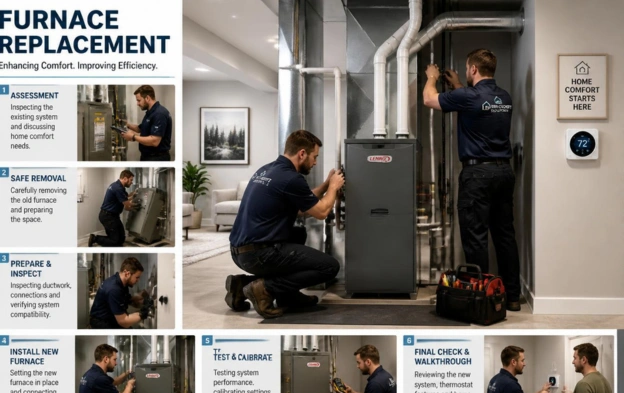
A typical project moves through these stages:
- Confirm the heating load and selected equipment.
- Shut down utilities and remove the existing unit safely.
- Set the new equipment and complete duct, fuel, electrical, vent, and drain connections.
- Start the system and verify airflow, combustion, controls, and safety functions.
- Complete required inspection steps and explain operation and maintenance to the homeowner.
What Changed With Federal Tax Credits in 2026?
Homeowners should be careful with older articles that still advertise the federal Energy Efficient Home Improvement Credit for a new gas or oil heating system. Current IRS guidance on the Energy Efficient Home Improvement Credit states that Section 25C is not available for qualifying property placed in service after December 31, 2025, following the accelerated termination of the credit. That means a system installed during 2026 should not be budgeted around the previous federal credit, although state, local, manufacturer, and utility programs can have separate rules.
Look at the House Around the Heating Equipment Too
New equipment cannot correct every comfort problem inside the building. If the mechanical area is part of a renovation, Renovixa’s basement-finishing planning guide covers insulation, climate control, and layout issues that can affect comfort and equipment access. Checking the surrounding space before installation can prevent a new system from being blamed for problems caused by the building itself.
Moisture and uncontrolled air movement can also affect basements, walls, and utility areas. Renovixa explains the difference between water, vapor, and air-control strategies in its home moisture-barrier guide, which is useful when the mechanical room has damp surfaces or nearby building-envelope concerns. Correct the source of moisture rather than hiding it behind new finishes or equipment.
Homes with ducts or mechanical components near a crawl space deserve similar attention. Renovixa’s crawl-space encapsulation cost guide explains how ground moisture, sealing, insulation, drainage, and humidity management may fit into a broader project. Fixing obvious enclosure problems can help the new heating system serve a more stable indoor environment.
Final Thoughts
A furnace replacement is a major home investment, but replacing an aging or unreliable heating system at the right time can provide better comfort, improved efficiency and greater peace of mind. For many U.S. homeowners, a replacement becomes worth serious consideration when the furnace approaches 15 years old, requires frequent repairs, produces uneven heat, causes rising energy bills or develops a significant mechanical or safety problem.
The cost of a furnace replacement in 2026 can vary substantially depending on the equipment, fuel type, efficiency rating, heating capacity, local labour rates, venting requirements, ductwork, permits and installation complexity. Rather than choosing a contractor based solely on the lowest advertised price, homeowners should compare two or three detailed, itemized quotes that clearly explain equipment, labour, removal, permits, venting, controls, warranties and any additional work.
Frequently Asked Questions
How much should a new heating system cost in 2026?
Many standard U.S. installations fall somewhere around $2,800 to $7,500, based on current national cost guides. High-efficiency gas systems, difficult access, new venting, duct changes, or additional utility work can push the installed price beyond that range. Compare local itemized proposals because national averages cannot account for your home, climate, labor market, and project scope.
How long does furnace replacement take?
A simple changeout can often be completed within one working day when existing ducts, utilities, and venting are compatible. Projects that require new venting, major sheet-metal changes, electrical work, fuel-line modifications, or difficult access can take longer. The contractor should inspect the property and explain the expected shutdown period before work begins.
Should I replace a 15-year-old heating system if it still works?
You do not need to replace functioning equipment solely because it reaches a particular birthday. Fifteen years is a sensible point to review repair history, efficiency, comfort, safety, and the cost of likely future failures, and ENERGY STAR specifically identifies that age as a replacement consideration. Planning before an emergency also gives you more time to compare contractors, equipment, and project scope.
Is higher AFUE always worth paying more for?
A higher rating means a larger share of the fuel becomes useful heat, so it can reduce fuel waste. The financial benefit depends on climate, fuel prices, annual heating demand, equipment cost, venting changes, and how long you expect to own the home. Compare the complete installed cost and estimated operating expense instead of choosing a model from the efficiency number alone.
Plan the Replacement Before the Old System Forces the Decision
Start by having the current system inspected and asking whether the problem is isolated, recurring, or safety-related. Then collect two or three itemized quotes that use comparable capacity, efficiency, installation scope, controls, warranties, and permit assumptions. A planned decision gives you a better chance to choose correctly sized equipment and a complete installation rather than accepting the first emergency option available.